

Doing the research on how to safely transition your dog to raw dog food can be a minefield. Feeding raw food is a topic that generates heated debate. In fact, switching your dog's food in general is not a step to take lightly. You first need to establish the reasons why you might want to change your dog's diet.
This guide is for dog owners who are considering switching their dog from 'traditional' or commercial dog food based diets to raw dog food. We'll explain the process for changing to raw as well as the steps you need to take to prepare your dog for a transition to raw food in a healthy way.
Raw feeding is based on the principle idea that, based on their ancestors and anatomy, dogs are designed to digest and thrive on raw meat but there are factors you need to take into account before switching – such as your dog’s age and activity levels, which allow you to choose the right food quantities and type.
The short answer to how to transition your dog to a raw diet is this – do it over 7-10 days and add raw in gradually. But how much should you feed? What should you do if your dog is still hungry? Should the process change if your dog has a chronic condition or is older? The long answer to the question is much more in-depth than simply ‘7-10 days’, so let’s explore.
Raw dog food: the basics
Biologically Appropriate Raw Food (BARF) diets are based on fresh foods such as raw meat and bones, seasonal fruit and vegetables and are designed to replicate your dog’s ancestral diet.
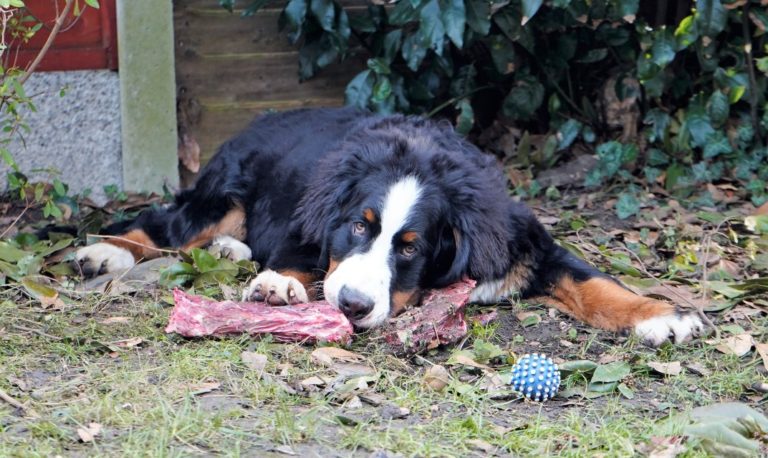
Just as human food finds itself under the microscope (ingredient suitability, traceability, sustainability, obesity) – phrases like ‘convenience’ and ‘mass-produced’ in pet food are being replaced by altogether more thoughtful or responsible notions such as, ‘natural’, ‘well-being’ and ‘nutritionally-balanced‘.
Emma explains what the main health benefits of feeding a raw diet are:
By feeding raw dog food, you can be confident that your faithful friend is getting all the essential vitamins, minerals and proteins they need to live a healthy, active life!
What are some of the biggest health reasons for converting to a raw diet?
Dog owners who feed a raw diet regularly share that their dog’s itchy skin, coat, teeth and joint conditions improve after converting to a raw dog food diet, according to Emma and her team.
How to transition your dog to a raw diet
The simplest answer to how to transition your dog to a raw diet from dry or wet food for the first time is to gradually introduce it over a period of 7-10 days. This allows you to introduce it and transition your dog gradually to cause as little disruption to their digestive system as possible.

Emma tells us that easing your pet into a high protein raw meat and bone diet is very easy and convenient and shares her top tips for how to transition your dog to a raw diet safely:
Step 1:
Replace a small spoonful of your dog’s current food with a small spoonful of raw equivalent per meal.
Please note: The spoon size will depend on the size of your dog – for example, a teaspoon would be appropriate for a toy breed dog and a tablespoon for a large dog.
Step 2:
On a daily basis, over the next 7-10 day transition period, gradually increase their intake of our raw food and reduce their previous food until the full transition is achieved – it’s as simple as that!
How much raw dog food should you feed?
How much raw dog food your dog will need will be based on a variety of factors, including their age, breed and lifestyle.
According to Emma, a good rule of thumb to understand how much raw dog food to feed is this:
As a rule of thumb, an adult dog should eat around 2-3% of its ideal body weight per day (e.g. a 10kg dog should eat roughly 200g of food per day).
For puppies, at about 8 weeks of age, they will need approximately 5-6% of their body weight per day, spread across 3-4 meals.
This will be required until the puppy reaches around 6 months of age. At this point, you may wish to reduce the number of meals to two, until they have reached maturity and are well placed to switch to the recommended adult diet.
What should you do if your dog still seems hungry on a raw diet?
Some dogs who have been on a high carbohydrate diet for a sustained period of time may initially at least, appear hungry as they adapt to a higher protein diet with fewer carbohydrates. This can happen if the switch over to a higher protein low carbohydrate diet is made too quickly,
If your dog experiences this, Emma suggests adding a small number of additional carbohydrates – such as sweet potato or butternut squash into their meal/s.
You can also give them some vegetables (soluble fibre foods) in between meals, such as carrot sticks.
Three additional tips for how to transition your dog to a raw diet
Using the two-step ‘how to transition your dog to a raw diet’ guide above you should be set for success. But what if your dog has a sensitive stomach or is older? Should you do anything differently?
It’s important to remember that one of the many benefits of raw feeding is the improvement of a dog’s overall wellbeing. It’s not uncommon for dog owners to say that feeding raw dog food can help to alleviate periods of excessive wind, diarrhoea or constipation.
So if you’re seeking advice on how to transition your dog to a raw diet and require some additional expert advice for peace of mind, Emma says:
If your dog has loose stool at any stage, you should:
– Reduce the amount of raw food for three days in order to stabilise the stool. Thereafter, you will be able to return to increasing their raw food levels.
If your dog is older or dealing with chronic disease(s), consider this:
– If your pet is elderly or dealing with any complex chronic disease e.g. end-stage cancers, animals on antacids or high levels of immune-suppressive drug therapy, then we would recommend you get expert help prior to beginning the transition to a raw diet.
And consider adding this supplement into your dog’s diet for the first month of feeding raw:
– For the first month of feeding them raw food, digestive enzymes and probiotics can be added to their diet. If they have any dietary issues or have been prone to diarrhoea or constipation, a probiotic paste is a perfect remedy!
What should you do after transitioning your dog to a raw diet?
Once you have gone through the 7-10 day transition period and your dog is now ready to be fed full time on raw, the fun begins.

This is because dogs can now begin trying a wider range of flavours through different raw dog food recipes, as well as raw dog treats.
This will help create variety and a natural balance in a dog’s diet and you can start to learn more about your dog’s taste buds.
Emma says:
We can help advise the most affordable way to enjoy our nutritious food depending on your dog’s weight and how much storage space you have.
They understand that a healthy diet plays a huge role in your pet’s life and are solely dedicated to providing customers and their furry friends with balanced and complete raw pet food of the very best quality.
A raw food diet for your pet means feeding as nature intended, free from artificial additives, colours, preservatives and fillers.

It’s amazing in favor of me to have a site, which is good in favor of my experience.
thanks admin